The Feynman Technique: 4 Steps to Learn Anything by Explaining It Out Loud
The Feynman Technique is a four step way to learn something by explaining it simply. Pick one concept, explain it in plain words as if to a beginner, notice where the explanation breaks and go back to the source, then simplify again with an analogy. If you cannot explain it simply, you do not understand it yet.
Most guides to the Feynman method are written for students. This one is for people at work who must understand a pricing model, an inherited codebase or a new policy by Friday.
What the Feynman Technique is, and where it came from
Richard Feynman was a physicist who shared the 1965 Nobel Prize in Physics. The technique is often credited to the way he studied and taught.
Feynman never published a four step recipe under that name, though. The neat version is a later summary, made popular by writers such as Scott Young and Farnam Street. Study guides like the one from the University of York now teach it as a standard learning technique.
The spirit of it does trace back to him. In his 1974 Caltech talk, Cargo Cult Science, he gave this rule:
"The first principle is that you must not fool yourself"
He added that you are the easiest person to fool. Explaining out loud is a fast way to catch yourself.
Why explaining something exposes what you do not know
Psychologists call this the illusion of explanatory depth. Rozenblit and Keil (2002) asked people how well they understood everyday things, such as a zipper, and then asked them to explain how each one works, step by step. After trying, people rated their own understanding much lower than before.
Rereading and highlighting feel like learning, because the material starts to look familiar. In general, learning research finds that producing an explanation works better, because it forces you to pull ideas from memory and connect them.
The Feynman Technique in 4 steps
- Pick one concept and write down what you already know.
- Explain it out loud in plain words.
- Find the gaps and go back to the source.
- Simplify, add an analogy, and explain it again.

Step 1: Pick one concept and write down what you already know
Narrow the topic until it fits in one sentence. "How our usage based pricing tier is calculated" works, but "pricing" does not. If your head is crowded, a quick brain dump by talking can clear it first.
Write the concept at the top of a note, then list what you know and the sources you will check. This takes five to ten minutes.
Step 2: Explain it out loud in plain words
Explain the concept to an imagined beginner: a new teammate or a smart 12 year old. Use no jargon unless you define it. Close the source first, or you test your reading, not your understanding.
Saying it out loud beats writing for this step. Speech is fast, you cannot stop to polish a sentence, and you can hear yourself stall. Aim for two to five minutes; the speech time calculator shows how many words fit. If it runs much longer, the concept is too broad. Record it, because you need it for step 3.
Step 3: Find the gaps and go back to the source
Play the recording back and mark each spot where the explanation breaks. Common signals of a gap:
- You hesitate, trail off, or restart a sentence.
- You say "basically" or "sort of" and move on fast.
- You use a jargon word you cannot define.
- You skip a step with "and then it just works."
- You cannot give a concrete example.
Go back to the source for those spots only, not the whole document.
Step 4: Simplify, add an analogy, and explain it again
Use shorter sentences, one analogy and one concrete example, then record a second take. Compare it with the first. Stop when it runs from start to finish with no gaps and a newcomer could act on it.
Three Feynman Technique examples from work
These are illustrations, not real company data.

Learning a pricing model before a customer call
First take: "Customers pick a tier based on usage. If they use more, they basically move up." The gap: you cannot say what happens when a customer goes over a tier mid month.
Second take: "Each tier covers a set number of API calls a month. Go over mid month, and you pay a small fee per extra call until the month ends. You only move up a tier when you choose to, like a phone plan with overage charges."
Getting up to speed on an unfamiliar codebase
First take: "A request hits the router, and then the controller handles it." The gap: you cannot say where the request is authenticated.
Second take: "A request first passes a middleware layer that checks the session token. Only then does the router send it to a controller. If the token is missing, it stops there, like a guard at the front door rather than one in each room." For a single bug rather than a whole system, rubber duck debugging applies the same idea line by line.
Summarizing a new regulation or policy for your team
First take: "The new rule says we have to keep records longer and report some things." The gap: you cannot say who it applies to or from when.
Second take: "From the start date, teams that handle customer payments must keep records longer and report certain issues within a set number of days. Everyone else is not affected." This is a learning method, not legal advice, so check the official text.
How to run the Feynman Technique with voice notes
Any recorder works. What matters is that you speak step 2, then play it back for step 3.
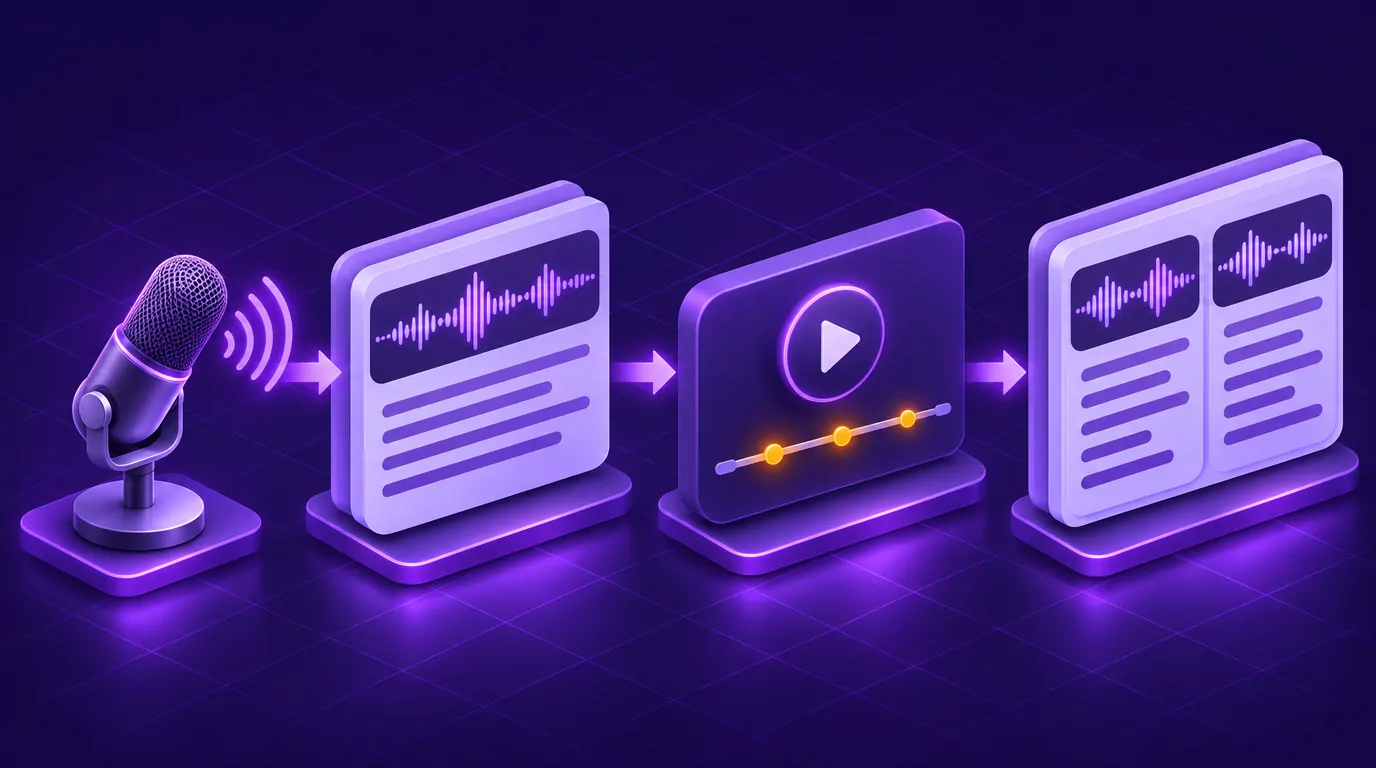
With VoiceSnap Pro voice notes on a Mac or Windows PC, it looks like this:
- Hold Right Command (Mac) or Right Ctrl (Windows), explain the concept, and release. For a longer take, press Control+Option+N or Ctrl+Alt+N to record hands free.
- The recording and its transcript are saved as a note in your account.
- For step 3, play the recording and listen for stalls. Judge by the audio, not the transcript.
- After step 4, record the second take as a new note and keep both.
The keyboard shortcuts guide covers changing the keys, and the FAQ explains how recordings and transcripts are handled.
One warning: do not let AI do step 2 for you. An AI summary of the source skips the effort that teaches you, a risk covered in cognitive offloading. Once you have your own explanation, an AI action such as shorten can test it: if the short version still makes sense, it holds up.
Keep your explanations: build a library of things you understand
The output of the technique is a short, plain explanation, and it is worth keeping. Next quarter, you want your own words, not a fresh start.

Tag each explanation with something like "explained," put it in a folder per project, and search for a word you remember later. For a full system, see building a second brain. A searchable commonplace book is a lighter way to collect ideas.
A week later, explain the concept again from memory as a review, and set a reminder on the note so you do. In VoiceSnap Pro the recording stays with the note unless you change the Keep recordings setting, and notes export as Markdown.
| Method | What it tests | Time | What you keep |
|---|---|---|---|
| Feynman Technique | Can you explain it simply? | 20 to 40 minutes | A plain explanation, two takes |
| Rereading notes | Does it look familiar? | Any amount | Nothing new |
| Rubber ducking | Does your logic hold? | 5 to 20 minutes | Usually a fixed bug |
| Teaching a colleague live | Can a real person follow? | 30 minutes or more | Their questions, if noted |
Common mistakes with the Feynman method
- Picking a concept that is too big. Shrink it to one question you could answer in a sentence.
- Explaining with the source open. If you can glance at the page, you are reading aloud.
- Skipping step 3 because it felt fine. A smooth explanation can still have holes.
- Simplifying until it is wrong. If an analogy breaks on an important detail, say where it stops working.
- Never doing the second take. The second take is where you prove the gaps are closed.
Do the whole loop in one deep work block.
Frequently Asked Questions
What is the Feynman method of problem solving?
Usually it means the learning technique above. People also share the joke "Feynman algorithm" (write down the problem, think very hard, write down the answer). It is usually credited to physicist Murray Gell-Mann, and it is a joke about Feynman, not a method.
How do you learn like Richard Feynman?
Feynman was known for curiosity, working from first principles, and explaining ideas to others. He also refused to treat the name of a thing as an explanation of how it works.
What is Richard Feynman's most famous quote about learning?
A strong candidate is from Cargo Cult Science: "The first principle is that you must not fool yourself". He added that you are the easiest person to fool. Many quotes online are wrongly credited to him, so trust only sourced ones.
Does the Feynman Technique work for studying?
Yes. It started as a study method, and the same four steps work for exams, one syllabus topic at a time.
Can you use AI with the Feynman Technique?
Yes, but only after you do step 2 yourself. If AI writes the explanation, you skip the part that teaches you, as cognitive offloading explains. Use AI to test your explanation instead: shorten it and see if it still holds.
Try it on one thing you have to understand this week
Pick one concept, explain it out loud for three minutes, and play it back. If you want each take saved as a voice note you can replay, tag and search, Download free for Mac or Windows; it is free to start, no card. Pro is $9 a month when you need unlimited transcription and manual AI actions, subject to fair use.